Tuesday, August 19, 2014

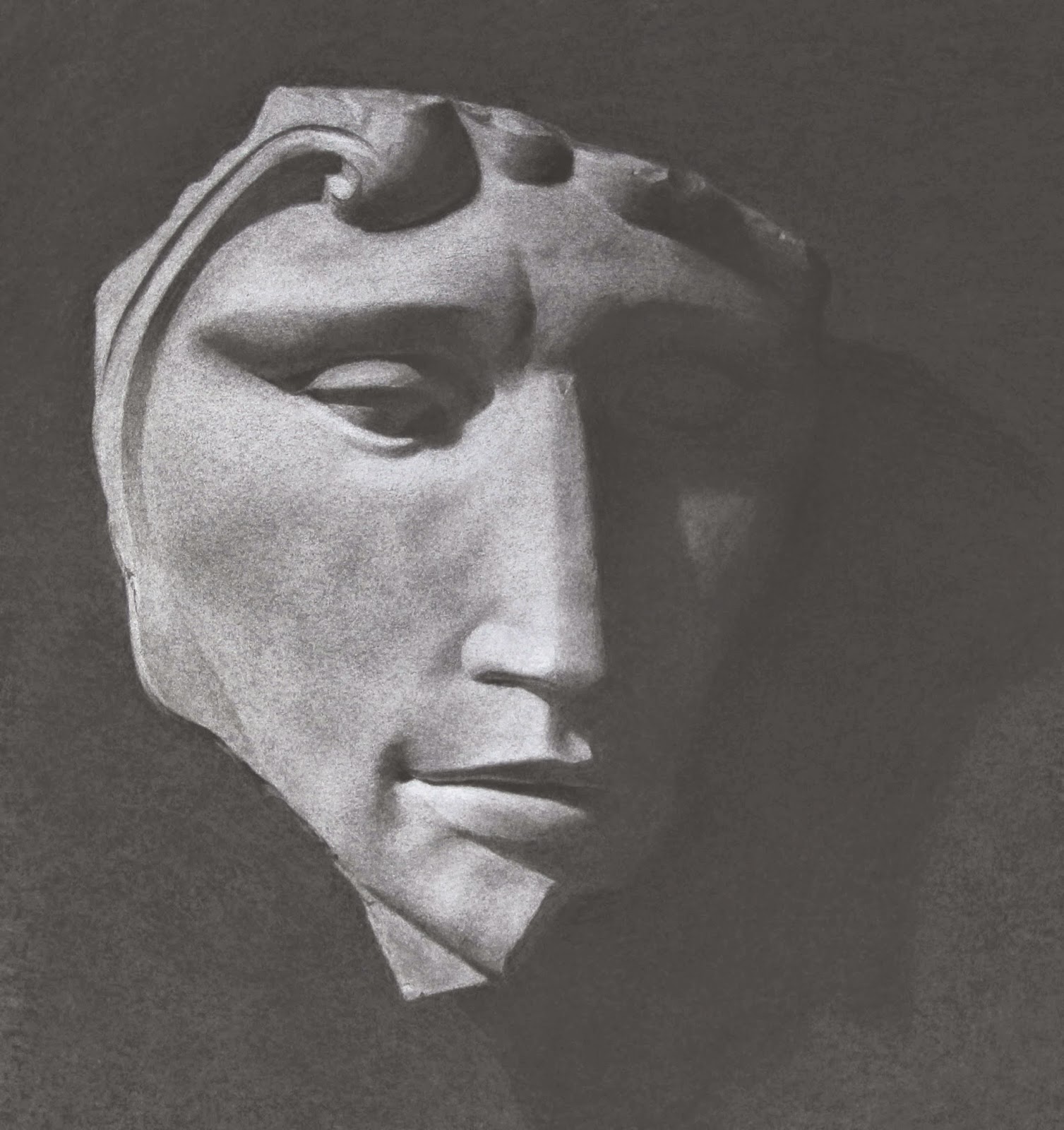
Third Cast Study


My third cast study is completed!!!!  I really think I am beginning to get value relationships now.  The perception of light and shadow is the most important skill in drawing and painting.  Value is one of the most important elements of realistic (or representational) drawing.  Values create the illusion of form and three-dimensionality. More specifically, the relationships between the values of an object make it look convincingly realistic.  If values are used unwisely or as an add-on, drawings will look overmodulated, muddy, and indecisive.  For more information on values check out this entry

http://georgetownatelier.com/tutorials/rendering-the-figure-part-


Charcoal on paper drawn from cast


Wednesday, April 2, 2014

The Slow and Silent Creation of Art

Even a stone, and more easily a flower or a bird, could show you the way back to God, to the Source, to yourself.  When you look at it or hold it & let it be without imposing a word of mental label on it, a sense of awe, of wonder, arises within you.  Its essence silently communicates itself to you and reflects your own essence back to you.  This is what great artists sense and succeed in conveying in their art.  Van Gogh didn't say: "That's just an old chair."  He looked, and looked, and looked.  He sensed the Beingness of the chair.  Then he sat in front of the canvas and took up the brush.  
Eckhart Tolle

Tuesday, April 1, 2014

Block-in Portrait study with Angela Cunningham

In October of last year I took another workshop with Angela Cunningham at the Townsend Atelier in Chattanooga, blocking-in the portrait from observation in graphite.  Angela's class emphasized understanding and practicing of the visual tools of blocking-in to develop measuring and shape-seeing abilities. Focusing on block-ins is a traditional academic training method that allows one to fine tune foundational skills for high accuracy.  Here is my block-in from the class with a value study I did following the class.  Of course, the portrait is not finished at all.  But this gives an idea of how accurate measuring in the very beginning creates a basis for a good likeness of the model.

Monday, March 31, 2014

Second Cast Study


Charcoal on paper drawn from cast


Casts are ideal for training the eye because they are white and completely still and they help a student to concentrate on shapes and values. Everything learned in cast work translates directly into drawing the figure and the portrait from life.   This is my second cast study....another 2-3 months work.


Friday, November 1, 2013

Cast Study in Charcoal

Studying cast drawing with Angela Cunningham helped me tremendously when I was ready to approach a cast study in vine charcoal with Jonathan.  This study was the very first one I have done concentrating on value relationships, shadow shapes, and edges.  This exercise teaches you to see the different types of shadow and also their shape and edges.   Some shadows have soft edges, some have hard edges and some are in between.  (To see a detailed description of values and how light shapes form check out this website:  huevaluechroma.com)

 Not only is charcoal harder to control than pencil, you have to make the lines match perfectly to the cast and you also need to match the values - the lights, the middletones and the darks. I spend about two and a half months on this one and learned a great deal.

Wednesday, August 28, 2013

Cast Drawing with Angela Cunningham


After copying the Charles Bargue plates (this is called working from the flat), an atelier student progresses to working from three-dimensional plaster cast, which is referred to as working “in the round”. In the cast drawing, the student begins to understand how controlled light falls across a three-dimensional form. In addition, this process enables a student to translate a three-dimensional object to a two dimensional picture plane, while maintaining the illusion of space and introduces the concept of “big form modeling.” This is where values and edges are introduced to the student and the concept of the ‘classical pattern of light on form’.

In April I attended my first cast drawing workshop presented by Angela Cunningham. This was a week-long workshop at Townsend Atelier in beautiful Chattanooga, TN.  Angela is an excellent teacher in the classical tradition. She studied at various art colleges in CA, ultimately earning her BFA in drawing and painting, with a minor in sculpture from Laguna College of Art and Design. After teaching in CA for a while, she decided to master the classical approach to drawing and painting and moved to NY to attend the rigorous Grand Central Academy of Art under Jacob Collins. Angela now lives and teaches in her new studio in Ashville, NC and at various other locations here in the Southeast.


               Here I am struggling with getting the tones and values correct after completing the block-in.

Tuesday, August 27, 2013

A Bargue Drawing using the Comparative approach

Comparative measuring (or sighting) is a way of measuring the size of what you see and using those measurements to draw a larger or smaller image of the same.   In comparative measurement, we try to find the relative scale of any part of the figure to any other. Need to know the length of the forearm? Measure it on the model and then compare it with something else on the model. Then make the same comparison on your drawing. For example, maybe you find that the length of the model’s forearm is equal to the width of the torso at the waist. Make the same comparison on your drawing, and if you see that the length of  your drawing's forearm is equal to the width of your drawing's torso, then there’s something correct about that relationship.  In comparative measuring, we don’t make direct measurements between the model and our drawing as we do in sight-size, but rather filtered through relative comparisons.    I completed this Charles Bargue plate under Jonathan's direction using the comparative measuring method instead of sight-size.


The Belevedere Torso
 After Charles Bargue
Graphite on paper